AI Animal POV Camera Experiment: Create Ultra-Realistic Biological Field Prompts
Artificial intelligence tools are now powerful enough to simulate scientific wildlife documentation with incredible realism. One of the most interesting prompt techniques is creating a micro back-mounted camera perspective on small animals.
In this workflow, the camera is imagined as a tiny research camera physically strapped to an animal’s upper back, allowing viewers to experience the environment from the animal’s natural point of view. The goal is not cinematic storytelling, but a raw biological field experiment feel—as if researchers are studying underground ecosystems in real time.
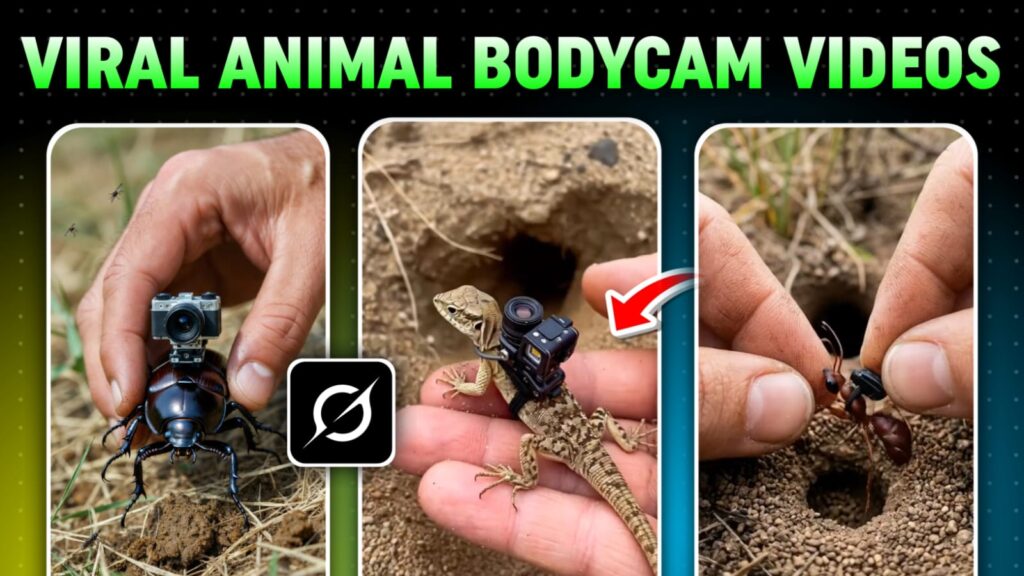
This article explains a two-phase prompt system that helps generate highly realistic AI prompts for animals that move across the ground or inside underground tunnels. The prompts follow strict rules to maintain realism, scientific accuracy, and believable camera physics.
Phase 1 – Selecting the Animal
The first step is choosing a small ground or underground animal capable of carrying a lightweight micro research camera. These animals are common in natural ecosystems and are often studied by scientists to understand colony behavior, food movement, and underground tunnel structures.
Below is a list of 15 biologically realistic animals with their English and Hindi (देवनागरी) names.
1. Ant — चींटी
A highly organized social insect known for complex underground colonies and structured tunnels.
2. Field Mouse — खेत का चूहा
A small rodent that frequently creates burrows and underground nests in fields.
3. Dung Beetle — गोबर भृंग
A ground beetle famous for rolling dung balls and navigating using environmental cues.
4. Mole — छछूंदर
A burrowing mammal specialized in digging tunnels beneath soil.
5. Termite — दीमक
A colony insect that builds massive underground networks and chambers.
6. Garden Snail — बगीचे का घोंघा
A slow-moving mollusk often seen exploring moist soil and vegetation.
7. Ground Beetle — भूमि भृंग
A fast-moving insect predator commonly found on forest floors.
8. Earthworm — केंचुआ
A soil-dwelling invertebrate that continuously moves through underground soil layers.
9. Cricket — झींगुर
A small insect often living in soil crevices and grassy ground areas.
10. Centipede — कनखजूरा
A multi-legged arthropod that hunts in dark, damp underground spaces.
11. Pill Bug (Woodlouse) — गुबरैला कीड़ा
A tiny crustacean that curls into a ball and thrives in moist soil environments.
12. Gopher — गोफर चूहा
A burrowing rodent known for creating extensive underground tunnel systems.
13. Desert Jerboa — जर्बोआ
A small hopping rodent living in desert burrows.
14. Shrew — छछूंदर जैसा छोटा स्तनपायी
A tiny insect-eating mammal that moves quickly through soil tunnels.
15. Burrowing Spider — बिल बनाने वाली मकड़ी
A spider species that creates underground silk-lined burrows.
After selecting an animal, the system automatically moves to Phase 2, where highly detailed scientific prompts are generated for AI tools.
Phase 2 – Scientific Prompt Generation
Once an animal is selected, the AI produces six structured prompts designed to simulate a real research experiment.
Each prompt describes a stage of the field experiment from camera installation to underground exploration.
The structure is always the same:
1️⃣ Image Prompt – Wildlife researcher attaching the camera
2️⃣ Motion Prompt – Animal begins movement
3️⃣ Motion Prompt – Entering underground tunnels
4️⃣ Motion Prompt – Exploring colony ecosystem
5️⃣ Motion Prompt – Deep tunnel navigation
6️⃣ Motion Prompt – Full colony environment documentation
These prompts follow strict realism rules so that the scene feels like authentic biological research footage.
Global Realism Protocol
Every generated prompt follows a scientific field documentation style, meaning:
- Vertical 9:16 aspect ratio
- Ultra-realistic wildlife observation
- Raw field experiment appearance
- No cinematic filters
- No fantasy elements
- No artificial color grading
- Natural environmental behavior
The viewer should feel like they are watching a real wildlife research recording, not a movie scene.
Extreme Camera Physics Rule
The most important rule in this workflow is camera physics realism.
The micro camera must behave exactly as if it is physically mounted on the animal’s body.
Camera placement rules
- Mounted on the upper back or thorax
- Attached with a visible micro harness
- Facing the same direction as the animal’s head
Movement behavior
If the animal turns → the camera turns.
If the animal lowers its head → the frame tilts downward.
If the animal bumps into something → a small camera jolt occurs.
Forbidden camera behaviors include:
- Drone-like following
- Floating camera angles
- Perfect cinematic stabilization
- Third-person view
At least 5–10% of the animal’s body must remain visible at the bottom of the frame, reinforcing the feeling that the camera is attached directly to the spine.
Underground LED Lighting Rule
Underground environments follow strict lighting rules.
Since natural sunlight cannot reach deep tunnels, the only light source allowed is a tiny LED research light mounted next to the camera.
This light behaves like a real exploration lamp:
- Narrow focused beam
- Uneven brightness falloff
- Strong reflections on wet soil
- Darkness beyond the beam
The effect should feel like a tiny research camera exploring complete darkness.
Large Colony Ecosystem Requirement
Underground environments must appear alive and active, not empty.
The prompts describe large ecosystems containing:
- Multiple branching tunnels
- Large underground chambers
- Hundreds of colony members
- Egg clusters and larvae
- Pupae development areas
- Food storage zones
- Organic debris piles
- Moist soil pockets
- Organized movement traffic
This ensures the environment feels like a living biological colony.
Prompt Structure Overview
Prompt 1 – Image Prompt
A macro wildlife photograph showing a researcher gently attaching a micro camera to the selected animal.
Prompt 2 – Motion Prompt
The animal begins moving and approaches its nest entrance.
Prompt 3 – Motion Prompt
The animal enters the tunnel and LED lighting activates.
Prompt 4 – Motion Prompt
The camera explores deeper into colony chambers.
Prompt 5 – Motion Prompt
The animal navigates complex tunnel systems.
Prompt 6 – Motion Prompt
The camera documents the full underground ecosystem.
Why This Prompt System Is Powerful
This structured prompt workflow allows creators to generate extremely immersive wildlife POV simulations while still maintaining scientific realism.
It combines:
- Biological behavior
- Camera physics realism
- Environmental accuracy
- Ecosystem complexity
The result feels like a miniature nature documentary filmed from the animal’s perspective.
What is an Animal POV camera prompt?
An animal POV camera prompt simulates a micro camera mounted on an animal’s back, allowing AI tools to generate realistic first-person wildlife exploration scenes.
Why use strict camera physics in AI prompts?
Strict camera physics ensures the camera moves exactly like it is physically attached to the animal, making the footage feel realistic.
What animals work best for POV prompts?
Small ground or underground animals such as ants, beetles, field mice, moles, and termites are ideal because they naturally explore tunnels and colonies.